
I may not have been a typical audience member when I attended the opening-night performance of Stage West’s What the Constitution Means to Me on October 19. After all, I’m a professor currently teaching a course on citizenship literature. I arrived at the theatre a few days after facilitating a class discussion on John Marshall Harlan’s famous dissenting opinion to 1896’s Supreme Court Plessy v. Ferguson case, which hinged on his rhetorically powerful (although then-unsuccessful) defense of the 14th amendment. And I’m in the midst of planning an upcoming visit to TCU on October 29 by an Indigenous Studies scholar, Dr. Jill Doerfler, who (along with another brilliant and community-engaged scholar, Dr. Gerald Vizenor) was actively involved in the re-writing of the White Earth Nation’s Constitution in Minnesota.

So constitutions—and thinking and writing about them—have been much on my mind. But my excitedly affirmative response to this Stage West production was far from unique. Our entire first-night audience was fully engaged throughout the performance, and the friend-group attending with me could hardly bear to leave off talking enthusiastically about the play in the lobby afterwards. At home, conversation continued into the next day. Now that’s a successful launch to a theatre’s new season (in this case, Stage West’s 46th.) So, while urging you to head to the show—which ends just before election day—let me share some thoughts about the many strengths of this production.

Photo credit: Evan Michael Woods
Why did this play, in this moment, strike such a positive cord?
One reason—and an argument for anyone reading this response piece to hurry and buy a ticket—is the impeccable timing of its scheduling. The play focuses on a main character looking back across past decades to a time when she competed in contests held in VFW halls wherein the competitors had to offer up pithy-but-accurate commentary on different elements in the US Constitution. Those presentations had to be factually accurate (something a lot of us seem to be longing for but rarely finding in politics these days) yet also grounded in a recognition that government documents, choices by political leaders, and citizen responses impact us and our daily lives in tangible ways. With a consequential election looming, this play speaks to us all.
Another cause behind our audience’s enthusiasm came from the evident commitment of the actors to their roles, under the empathetic direction of Stage West’s executive producer Dana Schultes. Lead actor Megan Noble, in particular, compellingly merged a mature adult perspective (including personal experiences across the decades since her adolescent competition successes) with an appealing re-embodiment of a teenage self’s enthusiasm in moments when she revisited what it was like to compete for the scholarships that made her college enrollment possible. Although few if any audience members could recall successfully putting themselves through a university education with money they earned in such crucibles (a key word in an early scene), we could all certainly identify with the pressures of transitioning between our high school selves, through stages of adulthood, some of them bringing unanticipated pain.

Photo credit: Evan Michael Woods
From her adult standpoint, protagonist Heidi spends a good deal of her commentary acknowledging those times of pain and linking them, often, to her gender. She tells an honest abortion story—one maybe more in line with most abortion experiences than some of the political ads we’re seeing right now, which strategically spotlight the horrors of women almost dying when a medical procedure is clearly justified, but a physician’s ability to provide it is prevented by post-Dobbs state laws. Even more compelling for me, playwright Heidi Schreck has her main character tie her own history to generations of women before her, suffering a range of gendered—and in many ways governmentally empowered—domestic abuse. Heidi is haunted by her mother’s and her grandmothers’ being relegated to marginalized citizenship, a status going back to the original US Constitution’s failure to (in the words of Abigail Adams) fully “remember the ladies.” If the Heidi character’s multiple moves to compare Constitutional marginalization based on gender to the sufferings of Indigenous and Black Americans didn’t always weave seamlessly into her personal reminiscences, that was no fault of the acting, but rather an understandable effort in a script hoping to expand the play’s purview as a critique of power hierarchies—no small goal, certainly, and one perhaps as admirable to take on as it is hard to achieve in dramatic text.
More effective than these bordering-on-lecture moments (I get it that professors like me should hesitate to criticize such a tendency) were the personal stories. Heidi’s did claim the biggest spaces and time in the production, of course. But one of the most memorable and effective, I found, came from Actor David Wilson-Brown, who had a dual role as a Legionnaire running the competitions Megan was recalling and a former supporter of her participation. Like Megan Noble as Heidi, Wilson-Brown excelled in a monologue moment–recalling a youthful experience (in this case, on a baseball field) that left its mark in his view of what American community can be like at its best, when we find ways to choose kindness over anger and frustration.
The play’s shift to a debate brought yet another character onstage in a role that is being shared by Ellen Reid and Solaris Khalid, with Reid shining in the production I saw. At this point, audience members became active responders as Heidi and her opponent sparred over whether or not the Constitution—as we now have it—has so many flaws that simply continuing to amend it will not suffice.
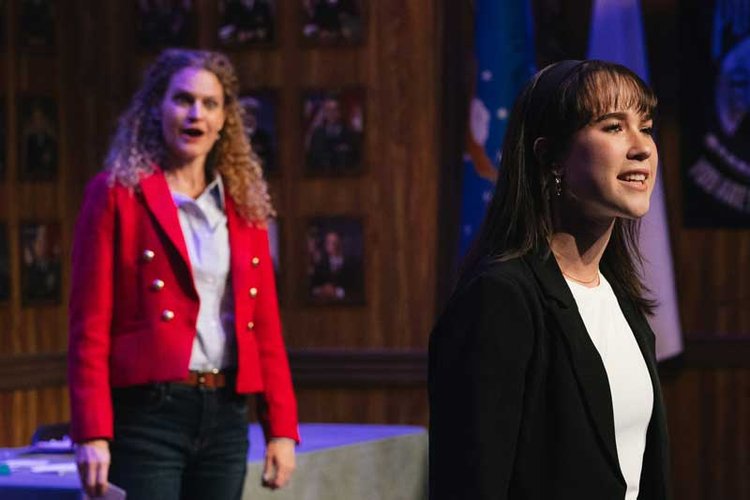
Photo credit: Evan Michael Woods
Here, as throughout the play, the well-crafted stage design seemed especially in tune with the content. Set up to embody the kind of VFW hall where an adolescent Heidi (sharing the same first name as the playwright, remember) would have competed, the long wall behind the two female debaters was filled with photos of male soldiers. This seemingly straightforward picturing of who has led America gained an added resonance during the debate scene. How can we continue to honor the service of this rich male heritage of past military men, while also making room for women’s leadership? And, in terms of the play’s title—with its invitation to any audience member to ask What the Constitution Means to Me—what might a new Constitution choose to include if women were more involved as framers than for our original version?
 Sarah Ruffing Robbins