
Early in the new Stage West production of “Primary Trust,” lead character Kenneth addresses the audience, offering up several interrelated observations about what they are about to see. “This is a story of how if you had asked me six months ago if I was lonely, I would have said–.” But then, after a brief pause, he adds, “This is the story of a friendship.”
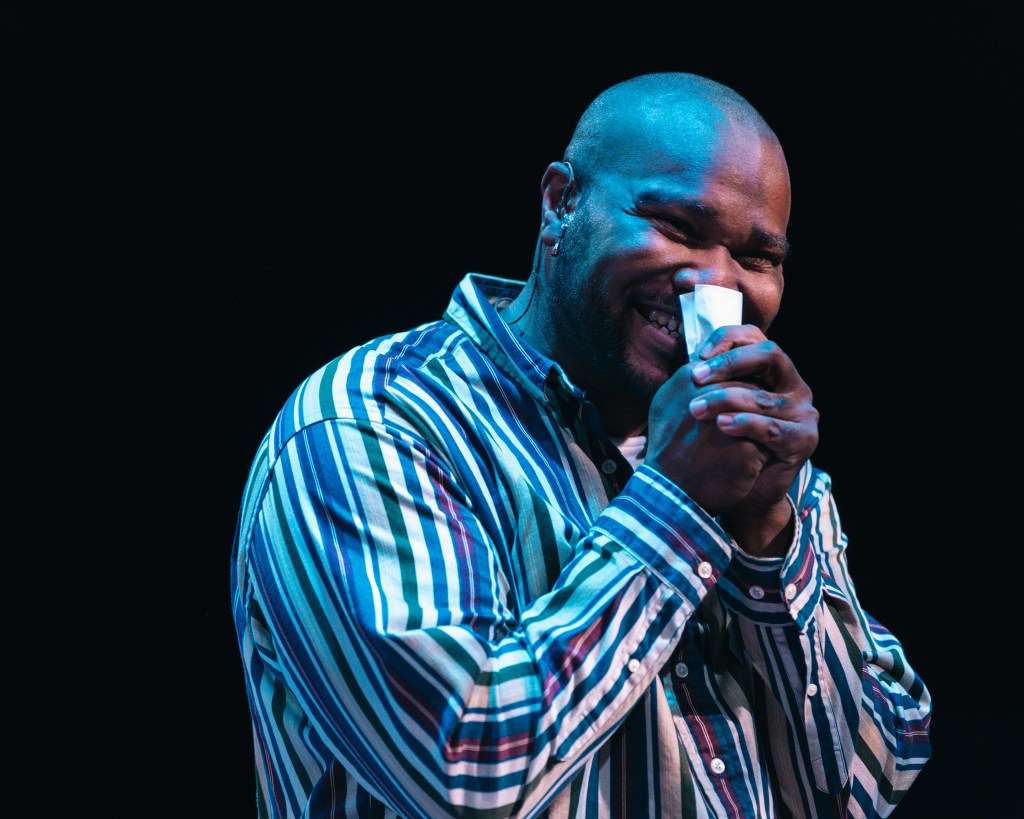
Lee George as Kenneth at Stage West; Photocredit: Taylor Staniforth | TaySten Photography
Balancing these two themes is just one of several successes in this bittersweet, yet uplifting, one-act play. Stage West’s four-person cast, under the visionary direction of Sasha May Ada, held the audience tight on opening night at the start its February run. Indeed, the four actors–including Lee George as Kenneth and Jamal Sterling as his first friend, Bert, along with Tiana Kay Blair and Brian Mathis (each juggling multiple roles)–are at the heart of the play’s focus on human relationships. Together, they demonstrate how attentive listening can move us from merely encountering each other to caring for each other. How being responsible for others makes us better ourselves. How escaping loneliness requires both another’s responsiveness but also our own embrace of trust.
Kenneth’s opening monologue lays crucial groundwork for the audience to focus on both characters and setting. He forecasts that striving to form interpersonal connections is just one element in our very human impulse to combat loneliness. Finding the right places to do so is also important.
That’s one of the most nuanced aspects of this remarkable script by Eboni Booth. I felt deeply, from my front-row audience seat, how this interplay between people and places raised intriguing questions. Kenneth’s story emphasizes interactions between place and friendship. I confess that during his initial commentary, I heard echoes of Thornton Wilder’s familiar “Our Town” in Kenneth’s description of his hometown of Cranberry. And I started forming assumptions about the play as maybe being an updated look at small-town northeastern life, both a nod to Wilder’s legacy and a reconfiguartion. Thus, Kenneth, sounding a bit like Wilder’s ruminating stage manager, noted: “Here in Cranberry (population: 15,000) our town motto is: ‘Welcome Friend, You’re Right on Time!'” He went on to talk about Cranberry as printing that motto on “the library cards and the municipal sign just off the interstate.”
Yet, there were immediately visible ways that this setting was not just a revisiting and revising of Wilder’s town. For one thing, as Kenneth acknowledges, “Cranberry is mostly white, but there are some Black people.” He is one of them. He confesses that he wonders “how my mother ended up in Cranberry,” since “She was originally from the Bronx and moved here all alone right before I was born.” This is a question that is never directly answered. One reason for that withholding may be that Kenneth–though on stage the entire time, like Wilder’s stage manager– isn’t a figure just explaining the town of Cranberry to the audience. Kenneth is the affective center of the play and all of its action. He is living its challenge of how to face loneliness himself, taking us into his feelings as well as his experiences. No, “Primary Trust” is not about small-town life in the same way of “Our Town,” where the community itself seems to claim center stage. It’s more about how individual people shape the intimate spaces within that community, and about how individual acts of care impact others.
One of those spaces is the locale most directly linked to the title, the Primary Trust bank where, with the the encouragement of a waitress who befriends him, Kenneth finds a job. Early in the action, he loses a place that had been one of his anchors–a local Main Street bookshop where he’s worked for Sam, the owner, for 20 years. Sam is selling the bookstore and moving to Arizona at the urging of his doctor. A two-packs-a-day smoker, this is his hope for surviving. But he knows losing this place brings a risk for Kenneth. Sam apologizes for not sharing news of his plans sooner. It’s just one of several roles in which Brian Mathis excels. Later, as Kenneth’s new employer at the bank, Mathis again shines. In both cases, an older white man could have become a mere stereotype boss of the younger Black protagonist. But thanks to the script, adept direction, and a subtle performance, instead we find a complex relationship which, echoing part of the title, builds “Trust.” Trust between two people. Trust across generations and racial differences. Trust that Kenneth has, we eventually learn, understandably had trouble embracing in his interpersonal connections.
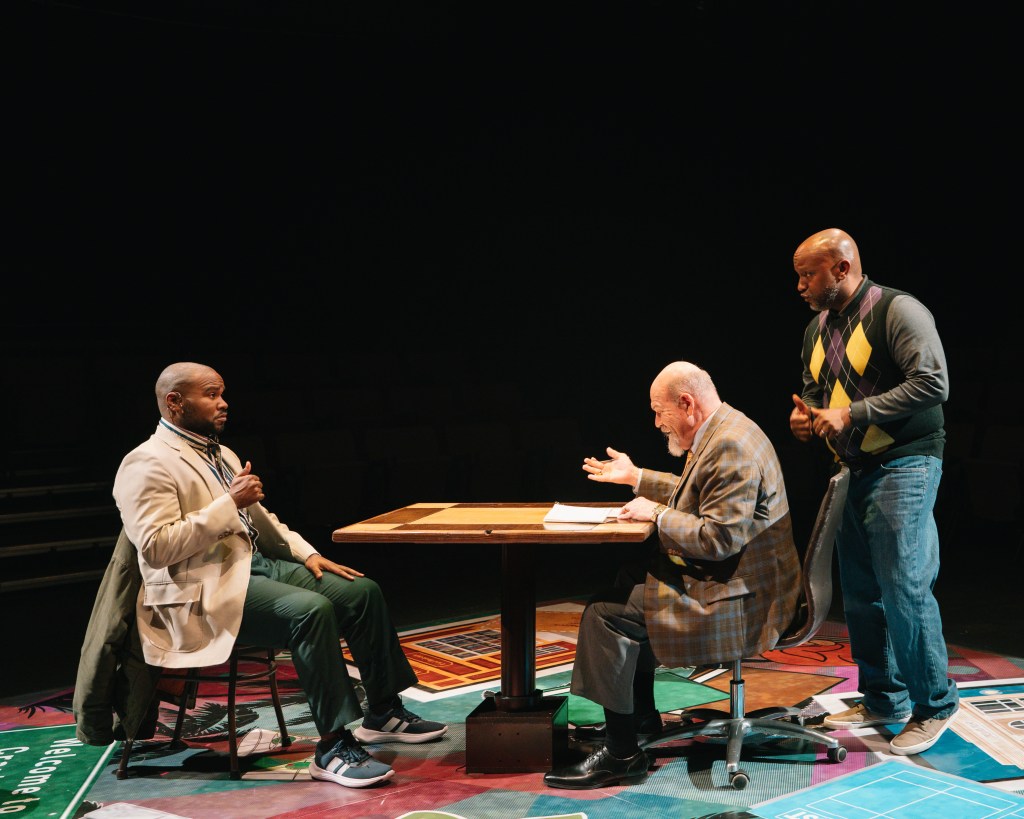
Brian Mathis (as Clay at the bank) with Lee George (left) and Jamal Sterling (right);
Photocredit: Taylor Staniforth | TaySten Photography
Which brings us to a second pairing and a second place, both crucial to the plot and the gradually-unfolding characterization of Kenneth: Wally’s. Wally’s is the bar Kenneth frequents along with his sole friend, Bert. But Bert, Kenneth admits to the audience very early on, isn’t a typical friend. As Kenneth tells us: “Not everyone can see him. No one can see him. Except me. He doesn’t really exist outside of my head.” When Bert and Kenneth talk animatedly at Wally’s, while Kenneth enjoys his favored Mai Tais, we in the audience DO hear and see Bert. But we have to keep reminding ourselves that Jamal Sterling’s very tangible, very appealing presence isn’t “real to anyone else” (per Kenneth’s admission) except our protagonist.
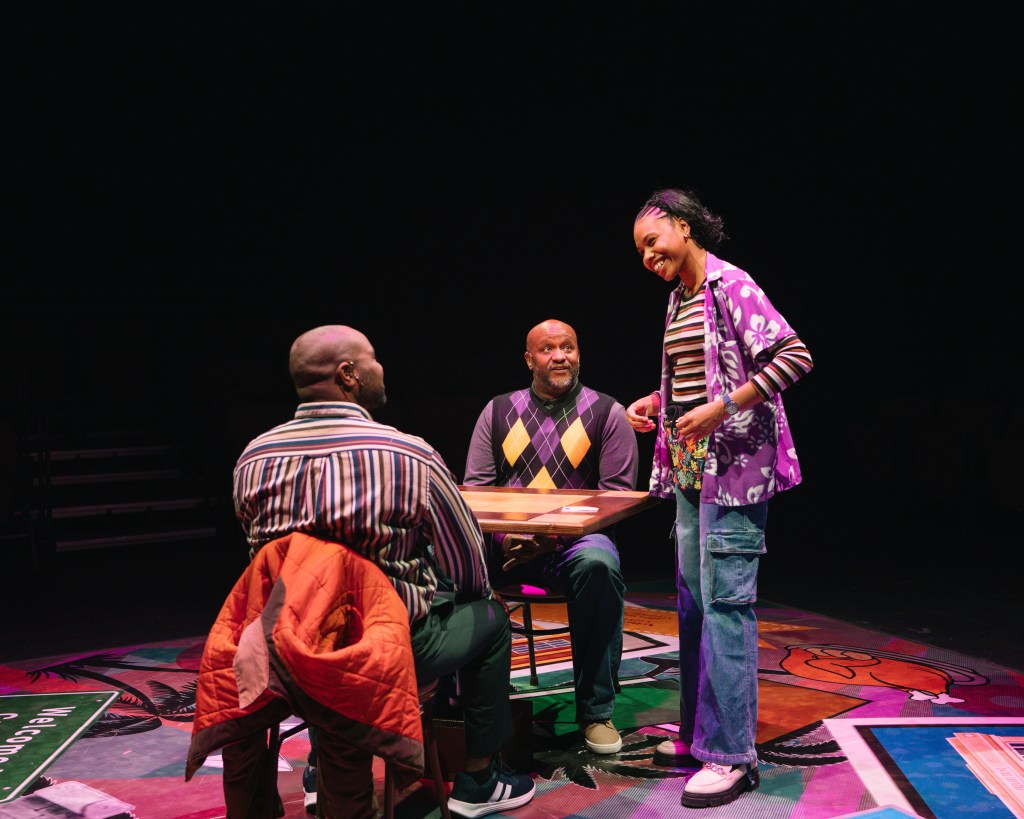
Kenneth and Bert at Wally’s: Lee George, Jamal Sterling, and Tiana Kaye Blair
Photocredit: Taylor Staniforth | TaySten Photography
Why 38-year-old Kenneth needs an imaginary friend becomes clear to us only as details from his childhood, and the years since, gradually unfold. Likewise, only in a series of small steps does Kenneth achieve a new level of connecting with “real” people–such as his new boss and one of Wally’s waitresses, Corinna (Tiana Kay Blair). This process emerges in a series of touching, but far from saccarhin, scenes. By the end of the play, the opening night audience of this new production at Stage West was giving a standing ovation not only to the fine cast, to the sparse-but-effective staging, to the well-designed costumes, and to the engaging storyline: we were also applauding for the possibilities the play signals, for the power of listening and caring for others.
In an interview for American Theatre magazine with Branden Jacobs-Jenkins, playwright Eboni Booth shared her surprise at some of the questions others had posed to her about “Primary Trust.” She’s been asked, she observes, if it’s about mental illness (given, after all, the presence of an imaginary friend) or alcoholism (in light of Kenneth’s so regularly frequenting Wally’s), In response, she notes: “I really want to be respectful of both of those issues,” and of some audience members keying in on those elements in her script (101). And yet, even as Booth mused along with Jacob-Jenkins that “I don’t want to tell anybody what to think or what to come away with,” she hopes for another element of her play to resonate most. How friendship can be an “antidote” to loneliness for us all: “really feeling connected and seen by other people” (101).
“really feeling connected and seen by other people”
I know I wasn’t the only member of the Stage West opening night audience keying in on that theme. In discussions among theatre-goers after the play and in comments offered up by Executive Producer Dana Schultes, the appeal of this focus was clear. A short essay by poet-playwright Sarah Ruhl in the same issue of American Theatre as the interview cited above shows Fort Worth audiences were far from unique in being drawn to this play on such terms. Ruhl recalled her own experience of “Primary Trust” as rooted in connection-making: “Though I did not know the people sitting on my left or my right, our aching compassion for the loneliness of the main character and the tenderness of our in-the-moment opening to artistic experience, made us feel like a newly formed community by the end of the evening.” So, during its run in Fort Worth until mid-February, take a friend to see “Primary Trust.” Trust that you’ll leave feeling better about our world. Or maybe take several friends to its upcoming Dallas Theater Center show of the same production. Or go on your own, in either town, and introduce yourself to the folks sitting near you. Trust they’ll be glad to meet you.
Sources informing this review:
Booth, Eboni. “Primary Trust.” [complete script with photos of the first performance at the Laura Pels Theatre in New York City] American Theatre (Spring 2024): 60-99. [Quotes in my review come from this published version of the script. In live performances like the one celebrated here, wording sometimes changes, of course. So, readers of this blogpost should not assume every line given here matches delivery on opening night in Fort Worth.]
Jacobs-Jenkins. “Eboni Booth: Only Connect: An interview with the playwright.” American Theatre (Spring 2024): 100-101.
Ruhl, Sarah. “All the Lonely People: We say theatre can be healing, but what if that were literally true?” American Theatre (Spring 2024): 54-55.

