
I want to sing praise for two Fort-Worth-based theatrical productions in this blogpost. But first I need to share a bit of context from July theatre-going beyond Texas that will help explain why I’m so proud of our local theatre scene. The Three Little Birds show Jubilee Theatre offered up recently as a multi-generational song-and-story fest and Stage West’s live-wire concurrent showcase of Fat Ham reminded me that, right here in my hometown, we have productions every bit as worthy of audiences as the more robustly funded offerings up there in New York.
I did see some super shows “up north” this July. With my sister Pat and our four daughters, I traveled to New York as we now do every summer to enjoy some collaboratively-chosen Broadway plays. Everything we saw was indeed wonderful—each show distinct in its wonderful-ness. I’d never watched the TV phenomenon Stranger Things, but the younger generation advocated for seeing its Stranger Things: The First Shadow prequel now showing at the Marquis Theatre. It was a worthy choice. If the technical effects—both ear-splitting and eye-astounding, over and over—have rightly garnered widespread praise, I’d also single out the nuanced characterization Louis McCartney brought to his lead performance. He made the eventually evil-doing Henry Creel sympathetic in a boy’s prequel stage of the pre-Creel-as-villain’s life. And, speaking of compelling acting—in a role with equally demanding physical energy—Meagan Hilty’s hilarious (yet also satirically critical of self-absorbed stardom) portrayal of Madeline Ashton in Death Becomes Her reminded me of why I’ve long been a fan. Whether her Glinda in Wicked or her Ivy Lynn in TV’s Smash, Hilty has always brought a special combination of lively wit and appealing fun whenever I’ve seen her performing.
Despite all the astounding special effects in both Death Becomes Her and Stranger Things, I’d have to agree with a number of pro critics and the Tony awards that maybe the most special new Broadway offering this year was Maybe Happy Ending. This one served up a charming love story for our times, even if the ending the “outdated” robots Darren Criss and Helen J. Shen achieved was ultimately only “maybe,” not fully secure.
I’m a longtime English teacher, though, so if I had to pick a personal favorite from everything we saw, it might well be John Proctor is the Villain. Fun, this play is not, although it has flashes of humor. Its plot builds to a “surprise” ending I was expecting all along. But getting there only involved a creative re-engagement with one of those plays most of us who teach American literature have at some point had in our repertoire—Arthur Miller’s The Crucible (which was also memorably, if indirectly, revisited on other grounds by George Clooney’s time saying “Good Night” on Broadway this spring. Resonating in the background of John Proctor for me, at the same time at the Crucible linkage played out, were different connections. With purposeful craft marshalled by playwright Kimberly Belflower, I noted the quiet-at-first hints of “me-too” stories. I literally shivered in my seat a few times at the portrait of a small-town Georgia classroom with complex intersectional dynamics building to an explosive climax. Sadly, this play didn’t offer much hope. A tiny glimmer, maybe, in a youthful former-sorority-girl, now young school counselor acquiring some enhanced awareness of how villainous behavior—if not blasting the stage like in Stranger Things—so often does its awful work right around us. Can we see? When we do see, what should our response be?
I took those questions home with me. They led me to watching a thought-provoking video interview with Belflower and Sadie Sink, who first took on the central character role in what is truly an ensemble cast. We saw Sink’s replacement, XX, who was excellent as YY. But folks who wish they could have caught Sink’s portrayal will be able to see a forthcoming film version, I hear. In the meantime, I’m now in the midst of informal research on this fascinating script, which was often produced by college/university companies before hitting Broadway. One of those productions, I was excited to see, utilized two different casts in Kansas at KU, under what I’m sure was compelling direction by a former colleague from our days together in Georgia, Jane Barnette. Wish I could have seen those shows!
Black Joy Embracing Everybody through Bob Marley Music
With Belflower’s John Proctor leading me to some moments of near-despair, I went looking for some theatrical joy again. And I found it back home. Two uplighting shows in Fort Worth—as I noted in my opening above—brought me back to feeling more unmitigated optimism about humanity than any of the outstanding Broadway productions had provided. Excellent as all those New York shows were, individually and collectively, they left me wondering if darkness, death, and loss, can ever really be overcome.
Maybe they can; maybe individual and collective agency for good is still possible. Three Little Birds and Fat Ham did both imagine as much for me, even if in very different ways.
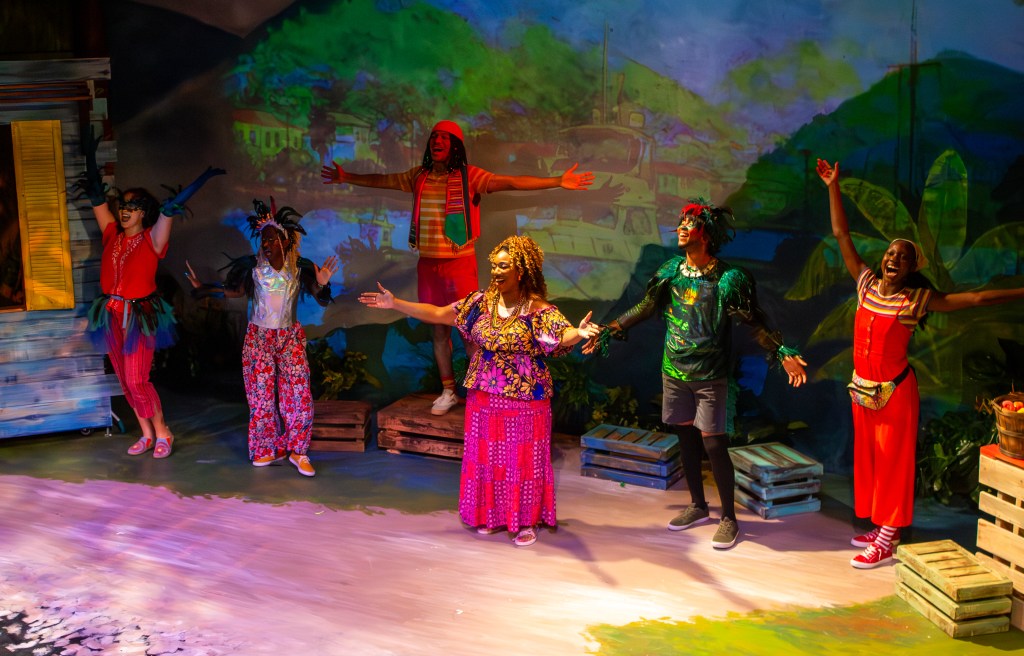
Jubilee Theatre’s upbeat Three Little Birds has already closed as I write this post. But a brief recap is still worthwhile to share, not only to celebrate the production itself, but also to embrace the vision for the theatre articulated the night I attended by the theatre’s Artistic Director, D. Wambui Richardson, in his welcome. In stressing the commitment Jubilee is making to cultivating a multi-generational audience that will help ensure this theatre’s (and all theatres!) future, the production of Three Little Birds aimed, he said, to welcome youth as our future in all domains, including attendance in these creative spaces. Other plays Jubilee will be offering soon won’t address kids as primary audience; some won’t even be age-appropriate for them. But Three Little Birds told a story of two young folks’ exploration of Jamaica in song and dance inspired by Bob Marley’s music, and in doing so demonstrated the continuing legacy of Marley as a source of communal hope through youth and their shared agency in tomorrows to come.
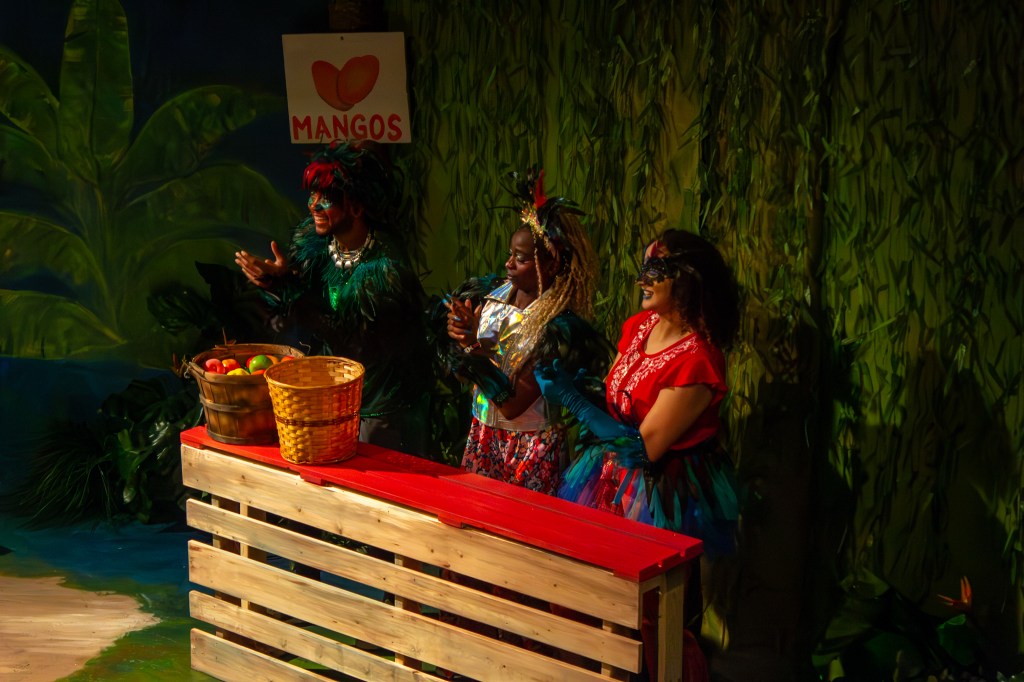

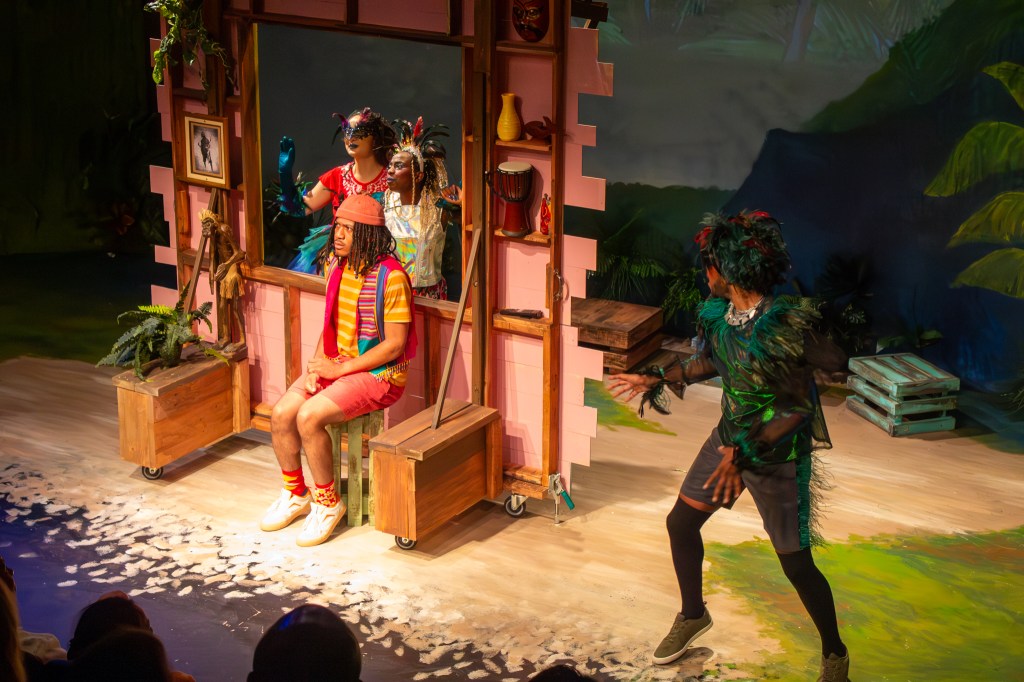

Scenes from Three Little Birds; Kyra McGhee, Photographer for Jubilee Theatre
Cedella Marley, whom the playbill reminded us playgoers is “the firstborn of Bob and Rita Marley,” used her skills as “a descendant of reggae royalty” to create this joy-giving musical by adapting her dad’s music to theatrical storytelling. Both the island itself and its music, along with the three little bird characters who sang and danced happiness throughout, become guides for the boy protagonist Ziggy (Evan Christopher Arnold) and friends and family to reaffirm seeking happiness by embracing life where we are. In this play, there was again a villain (Duppy, energetically played by AJ Bowman Shelton).

Photo by Kyra McGhee for Jubilee Theatre
But, unlike in Stranger Things or John Proctor is the Villain, Duppy’s “bad” force never seemed truly frightening in the face of so much lively love and energy in the setting and among the characters—a theme ably reenforced by the lush multi-colored imagery that spread in reaffirming Caribbean waves of sun, sea, sky, and forest throughout the one-act show.
When I left Three Little Birds, I was singing Marley lyrics I love. But I was also feeling truly optimistic again about where the world can be, where we can hope it will go.
Fat Ham Takes on Hamlet
Like Three Little Birds, Fat Ham emerges from adaptation. But whereas Cedella Marley’s reconfiguration of her father’s music celebrates its positive cultural power, the Fat Ham Pulitzer-winning script by James Ijames becomes more of a refutation of its forebear. (As I write this post, you can still see Fat Ham at Stage West; hurry on out and get your ticket.)
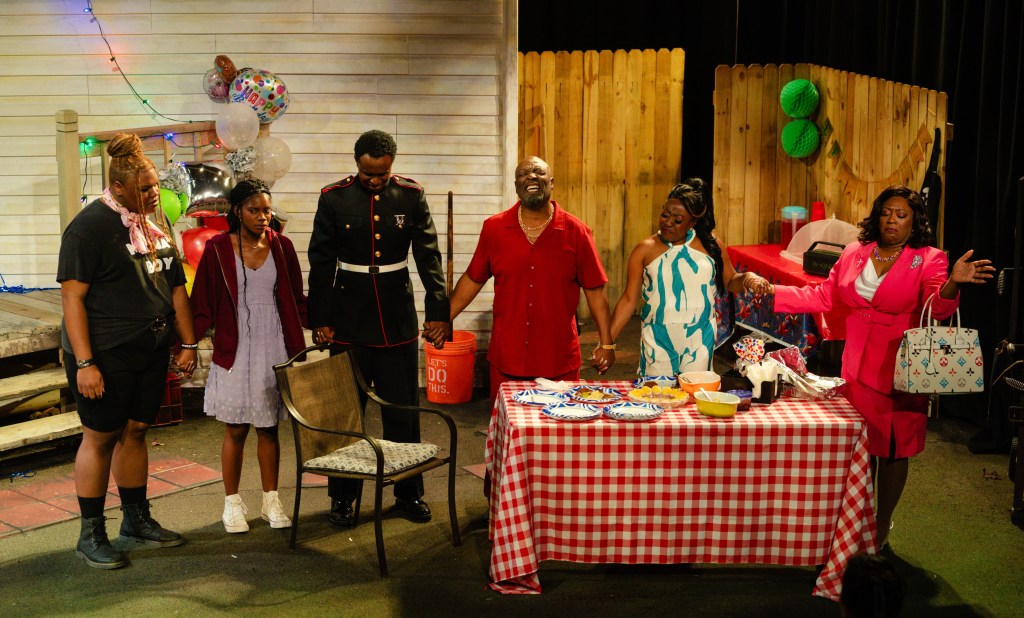
Cast of FatHam at Stage West in Fort Worth; photo by Evan Michael Woods for Stage West
L to R: Tyler Ray Lewis (Juicy), Jori Jackson (Opal), Caleb Mosely (Larry), Calvin Gabriel (Rev), Nikka Morton (Tedra), and Cherish Love (Rabby)
James Ijames, who himself played Hamlet as an actor, began asking himself questions about elements in the British author’s storyline that would be true to any cultural context, and things that might be different in a more current Black American cultural context. In an interview with journalist Barbara Bogaev for Studio Theatre, Ijames said that, for his own retelling, “there were things I wanted to change.” As in Shakespeare’s play, Juicy, the title character in Fat Ham is faced with a dilemma brought on by a ghost. In both scripts, the protagonist’s spectral father demands revenge for being killed by his brother, Hamlet’s/Juicy’s uncle, who also wed the now-ghost’s wife in very quick fashion afterwards. For Ijames, one point of resistance to the earlier Shakespearean account resided in its refusal to grant full agency to the younger generation—not just around the demand for vengeance the father figure asserts, but in how they would live their lives. So while, Ijames explains, “All of the younger folks in the play [including Larry/Laertes and Opal/Ophelia] have to make decisions about whether or not they want to continue their family’s cycles of trauma and violence,” these same young characters also should have opportunities to “get to some sort of place where the audience can see how the world could get better.”
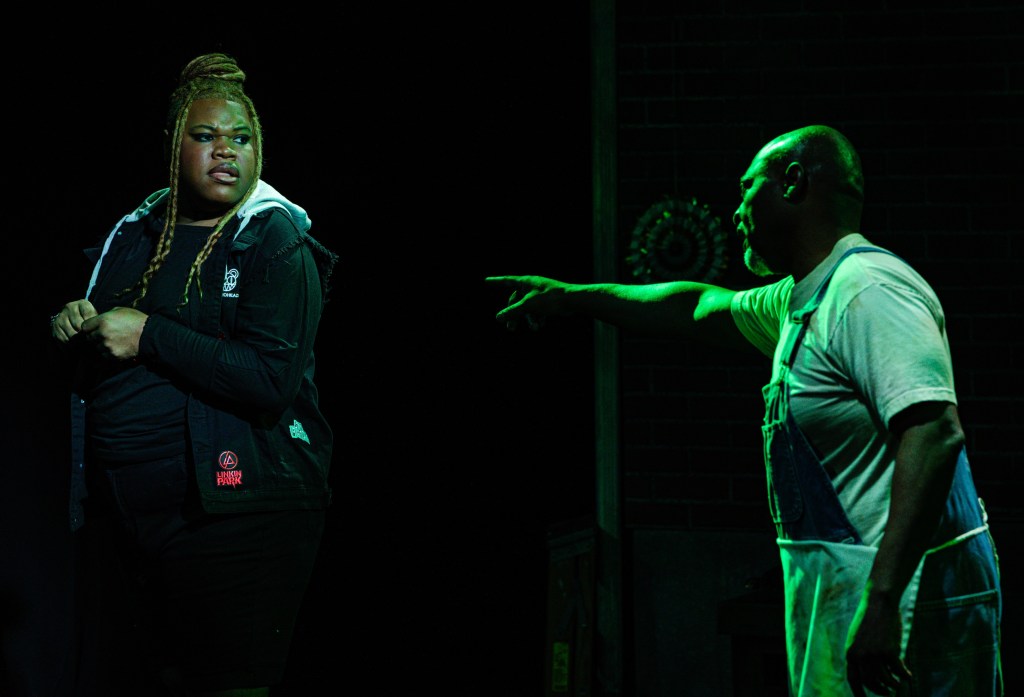
Juicy confronted by his vengeance-seeking father (who also plays Claudius); photo by Evan Michael Woods
Tyler Ray Lewis as Juicy, Calvin Gabriel as the ghost of Juicy’s father
This scenario sounds quite philosophical, of course, something the character playing the Claudius figure (Rev) calls out Juicy about at one point in their tense verbal—sometimes physical—conflicts. It’s addressing dark issues of family and identity, of responsibility to heritage and responsibility to oneself today and tomorrow. So Fat Ham could have easily become just a re-timed and re-placed melodrama, foreboding in tone. But James Ijames’s clearest brilliance comes, I found, from his ability to make this complex questioning funny, again and again. Not a scene goes by without laughter leavening the seriousness of what Juicy (Tyler Ray Lewis), Larry (Caleb Mosley), and Opal (Jori Jackson) face. There’s broad social satire throughout. There’s physical humor. There’s pointed wit tied to characterization. Indeed, Ijames’s most powerful gift to this play’s audiences may well rest in the play’s laugh-out-loud energy; that tone makes it possible to face the play’s serious questioning of how youth can find themselves amid the toughest challenges that all families tend to generate. And special credit should go, in this regard, to the insightful performances of the “elders” in the ensemble. Calvin Gabriel (as Rev/Pap), Nikka Morton (as Tedra), and Cherish Love (as Rabby) all shine in their roles. The intense hatred and exasperated frustration I’ve always felt for Claudius (Hamlet’s uncle), Gertrude (Hamlet’s mother), and Polonius (father to Laertes and Ophelia) never emerged as I watched these parental figures try various strategies for enforcing their will on the younger generation: humor made even these youth-suppressing figures human.

Juicy, Tio, and Opal with much-re-imagined Polonius character–now a dynamic mother figure; photo by Evan Michael Woods
Tyler Ray Lewis (Juicy), Zachary J. Willis (Tio), Jori Jackson (Opal), Cherish Love (Rabby)
As noted above, Fat Ham is still playing at Stage West as I write. So readers hopefully still have time to see this award-worthy production. And if you think Zachary J. Willis’s Tio hilariously steals the show in his opening physical comedy linked to social satire at least as adept as Meagan Hilty’s opening scene in Death Becomes Her, you will be even more impressed by Caleb Mosley’s closing tour-de-force. Yes, on Broadway Louis McCartney terrifies at the center of pyrotechnics at the end of Stranger Things, but Mosley’s Larry has an equally climatic close to Fat Ham’s production at Stage West. And it’s a far more joyful one. Let’s all celebrate and join in this joy.
 Sarah Ruffing Robbins